


Crude oil is a core commodity in our modern world. It is the raw material used to create everything from the fuel in our tanks to the plastics, chemicals, and essential compounds that power global industry.
Because oil is so vital to the global economic system, it is more than just a commodity—it is a financial pulse. The price at which it trades serves as a critical benchmark that guides global markets, sets inflation expectations, and influences government policy across every continent.
There are two major global crude oil benchmarks – Brent crude and West Texas Intermediate – each based on the prices of crude oil originating from different geographical regions, and with slightly different physical characteristics as well.
While many traders watch the US-based WTI, the international standard is often set by Brent crude. In this article, we’ll dive into the world of Brent crude oil trading, explore the factors that have shaped the Brent crude price history, and show you how to analyse a Brent price chart for trading opportunities
Key Points
- Brent crude oil, extracted from the North Sea, is a major global benchmark for oil prices due to its light and sweet characteristics, making it easier to refine and highly valued in the global market.
- The price of Brent crude oil significantly influences global energy prices and serves as a benchmark for nearly 80% of globally traded physical crude oil, highlighting its pivotal role in economic and market dynamics.
- Trading Brent crude oil involves futures and options on major exchanges, offering opportunities for hedging against price volatility and speculation, reflecting its central role in global commodity markets.
What is Brent Crude Oil?
Brent crude oil refers to crude oil extracted from the North Sea, off the coast of Europe, from several oil fields, including Brent, Ekofisk, Forties, and Oseberg.
We already know that crude oil is an essential natural resource that underpins the global economy. The price of Brent crude oil is a key indicator in the global oil market, and its fluctuations can significantly affect energy prices worldwide.
The Brent crude oil price is often referenced in financial and commodity markets and serves as a benchmark for pricing many oil-producing countries’ exports. As of the time of writing, around 78% of globally traded physical crude oil is priced off the Brent benchmark, either directly or indirectly [2].
But why is Brent crude oil regarded as a global market benchmark?
The answer lies in the relative ease with which Brent crude oil can be distilled into petroleum and refined into petroleum-based products, which is where the majority of the commodity’s value is found.
Brent crude oil is classified as “light” and “sweet”, meaning that it has a lower density and has a sulphur content lower than 0.5%. These characteristics make Brent crude oil easier to refine, compared to crude oils that do not have these properties [1].
History of Brent Crude Oil [3]
The story of Brent crude is essentially the story of the North Sea oil boom. While oil and gas were found onshore as early as the mid-1800s, it wasn’t until the UN’s 1964 Convention on the Continental Shelf that the door to offshore exploration truly swung open.
The First Discoveries
The timeline of Brent crude price history begins in the late 1960s with a series of massive deepwater discoveries:
- 1969: Phillips Petroleum strikes oil in the Ekofisk field (Norwegian sector), marking the first major offshore find in the North Sea.
- 1971: The massive Brent oil field is discovered, followed quickly by other major sites like Ninian and Oseberg.
Becoming a Global Benchmark
As production ramped up, various oils from the North Sea with similar qualities were grouped into a single “Brent Blend.” Because this oil was “light and sweet” (easily refined into high-value fuels), it became the benchmark for pricing.
Throughout the 1980s and 1990s, Brent became a dominant global benchmark for crude oil prices, particularly in European and Asian markets. It became a key indicator for traders, analysts, and policymakers, influencing investment decisions and economic forecasts.
Modern Challenges and Decommissioning
By the early 2000s, the original fields began to run dry. This shift eventually led to the official decommissioning of the original Brent oil field in 2017.
However, the benchmark didn’t disappear. To maintain the accuracy of the Brent crude oil share price, the “Brent Blend” was updated to include oil from newly discovered North Sea fields.
What is Brent Crude Oil Trading? [4]
Following the major oil shocks of the 1970s, crude oil trading shifted from simple “handshake” deals to futures markets. This change was designed to stabilise costs and prevent extreme economic damage.
Trading Brent crude oil can be performed using Brent futures contracts found on the Intercontinental Exchange in Europe, as well as the New York Mercantile Exchange (NYMEX). There are also option contracts linked to North Sea Brent crude.
Traders in this market generally fall into two categories:
1. Hedgers: Trading for Protection
For many, trading oil is about survival rather than profit. “Hedgers” use the market to lock in prices and protect themselves from sudden spikes in Brent crude oil prices. These companies include
- Crude oil supply chain: Refineries and petrochem suppliers
- Fuel-dependent sector: Airlines
2. Speculators: Trading for Profit
Brent crude oil can also be traded speculatively to generate profits.
Why Trade Brent Crude Oil? [5]
Brent crude oil is a powerhouse energy commodity. But why exactly should it earn a spot in your trading strategy?
Diversification
As a physical commodity, Brent crude has little to no correlation with the broader equities market. This makes it an excellent candidate for diversifying a stock-heavy portfolio. While rising oil prices sometimes precede a recession, oil operates on distinct supply-and-demand fundamentals.
Inflation hedge
Crude oil has its own intrinsic value that is not linked to currencies. This renders the commodity resilient against inflation. Even if currencies depreciate due to inflation, crude oil can retain its value, providing investors with a hedge against inflation.
Safe haven asset during market downturns
What happens when traditional markets panic? Investors often look for tangible value. While oil demand can fluctuate, it ultimately remains an irreplaceable global resource. This allows it to act as a stabilising safe haven during periods of extreme market turmoil.
Looking for insights into safe haven assets? Dive into the Vantage Markets podcast to explore the intricacies of safe haven assets. Click here to listen now.
Potential for speculation
If you look back through Brent crude oil price history, you will immediately notice periods of extreme volatility. A glance at a Brent price chart during historical oil crises shows massive, rapid price swings. For speculative traders, this volatility creates distinct opportunities to pursue high rewards (though it naturally carries high risk, too).
Start Trading Today: Open a live account with Vantage to trade oil Contracts for Difference (CFDs). CFDs allow you to participate in the fluctuations of Brent crude oil price, giving you the flexibility to seize opportunities whether the market is trending upwards or downwards.
Historical trends of the Brent crude oil market
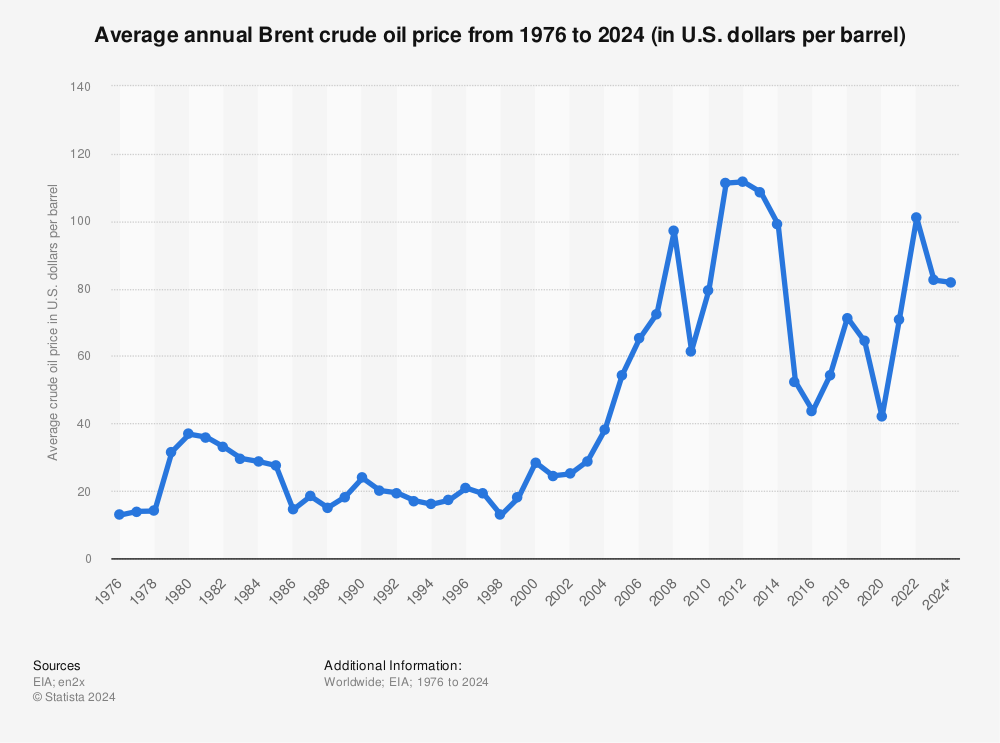
Take a look at any long-term Brent price chart, and one thing becomes immediately clear: this market is a rollercoaster.
Despite being the global benchmark referenced by nearly 80% of the world’s oil market, the Brent crude oil share price is notoriously volatile [6].
Let’s zoom in on a few recent periods of extreme volatility in the Brent crude price history to understand exactly what drives these wild swings.
2004 to 2008 [7]
Between 2004 and 2008, Brent crude prices skyrocketed, breaking previous records to hit nearly $100 per barrel at their peak.
Why the sudden surge?
- A massive supply-demand mismatch: Global oil demand surged, but producers simply couldn’t ramp up extraction fast enough to keep pace.
- The complexity of oil: Increasing production isn’t as simple as flipping a switch. There is extraction, production, storage and distribution. It requires massive infrastructure investments, high capital costs, and years of lead time to bring new facilities online.
- A storm of disruptions: Worker strikes, militant attacks, depleting oil fields, legal battles, and the aftermath of the Iraq War put a severe stranglehold on global supply.
Then came the crash. The Great Recession of 2008, triggered by the collapse of the US housing market, caused global demand to evaporate almost overnight. By 2009, Brent crude prices had plummeted by nearly 40%.
2014 to 2016 [8]
Following the recession, prices recovered and set new record averages in 2011 and 2012. However, this stability was short-lived. By 2014, a sharp multi-year decline began and ended in 2016.
So, what happened then? Well, the world was sitting on a growing glut in oil supply, which means cheaper oil prices were on the horizon. But the expected economic growth failed to materialise, flooding the market with an oversupply of oil.
Here is what triggered the collapse:
- The US Shale Boom: Rising efficiency gains lowered breakeven costs significantly, making US shale oil much more competitive on the international oil market.
- Weakening Global Oil Demand: Just as the market was flooded with new supply, major oil-importing economies (including the US and China) experienced economic slowdowns, while non-oil commodity-exporting emerging markets also slowed between 2015 and 2016, crushing demand.
- Pessimistic Price Forecasts: Analysts continually downgraded their long-term forecasts due to the rise of fuel-efficient technologies, renewable energy policies, and the seemingly endless supply of shale oil.
2020 to 2022
This era completely rewrote the rulebook for energy markets. Between 2020 and 2022, average prices swung violently from $41.96 per barrel all the way up to $100.93 [9].
How did we get there?
- The COVID-19 Crash: In 2020, pandemic lockdowns obliterated consumer demand. Combined with fierce disagreements between oil-producing nations, prices crashed to unprecedented lows, causing massive underinvestment in production facilities.
- The Recovery: As the world reopened, demand roared back to life much faster than anticipated.
- Severe Supply Constraints: The market was suddenly hit by lockdown-induced supply chain bottlenecks, unusually harsh winters, and the outbreak of the Russia-Ukraine war. This created a perfect storm that drove prices sharply upward for two solid years.
Brent Crude Oil prediction
As at December 2023, analysts have expressed caution towards crude oil price recovery in 2024. This is despite planned production cuts from OPEC, the impact of which is expected to be offset by resilient non-OPEC supply and slower-than-expected consumer demand. Based on a survey of 30 analysts, crude oil price is expected to be priced around USD 84.43 per barrel in 2024 [10].
There could be further instability ahead. Due to the ongoing Gaza Strip crisis, there is a heightened threat of war in the Middle East. This could severely disrupt oil supply and drive up oil prices, creating further shocks to global economic recovery, and kicking off another cycle of high inflation [11].
What affects Brent crude oil prices? [12,13]
Wondering what actually drives the market?
Based on the historical events we just covered, it’s clear that the Brent crude oil share price doesn’t move by magic. It is driven by three main engines: supply and demand levels, macroeconomic factors, and geopolitical issues.
Let’s break them down.
Supply and demand levels
It sounds intuitive: if demand for oil increases or physical supply falls, the price of Brent crude should rise, and vice versa.
But here is the catch.
The vast majority of crude oil trade doesn’t occur with physical barrels; it occurs in futures markets. Here, oil is traded via future contracts – binding agreements that give one the right to purchase oil by the barrel at a predefined price on a predefined future date. Under a futures contract, buyers and sellers are obligated to fulfil their side of the transaction on the specified date. The actual Brent price chart often diverges from basic supply-and-demand expectations.
For instance, in early 2020, oil producers around the world agreed to historic production cuts to stabilise prices, but to no avail. Driven by COVID-19 economic slowdowns, crude oil prices fell to a 20-year low.
Crude oil prices are also sensitive to market sentiment, which, again, is exacerbated by the mechanics of futures contracts. If traders simply believe prices will rise, they will rush to buy futures contracts, creating a self-fulfilling price spike. The opposite is also true.
Hence, while supply and demand remain a fundamental driver of Brent crude oil prices, be aware that the customary behaviours may not apply.
Macroeconomic factors
Given the ubiquitous nature of petroleum by-products, oil is deeply intertwined with the global economy.
To put it simply:
Oil drives global growth just as much as economic growth drives the oil demand. You cannot have one without the other. When major economies are booming, shipping increases, factories run at full capacity, and the demand for Brent crude soars. Conversely, during a recession, industrial and consumer demand plummets, pulling prices down with it.
Geopolitical Issues
If you look back through the history of Brent crude oil prices, you’ll notice that geopolitical shocks are responsible for almost every major market disruption.
Here are the primary geopolitical triggers to watch:
- Conflict in Oil-Producing Regions: Wars and international sanctions can instantly choke off supply. For example, when Russia (the third-largest global oil producer) invaded Ukraine, the international community imposed economic sanctions. Oil prices surged immediately on the expectation of a reduction in global supply.
- Cartel Actions: The Organisation of Petroleum Exporting Countries (OPEC) is a group of 13 oil-producing countries that together control 40% of the world’s oil output. OPEC is widely recognised as the largest influencer of oil prices, with the organisation raising or cutting production to exert control over the market.
- Government Policies: Legislation matters. Green initiatives that mandate reductions in oil and gas use across industries could reduce oil demand. This may prompt oil producers to reduce supply, potentially triggering a price spike during periods of high demand, such as winter.
Types of Brent Crude Oil trading
While most Brent crude oil trading occurs in futures markets, these contracts are complex, carry high risk, and may be suitable only for highly advanced or experienced investors. Less-experienced retail investors seeking to access trading opportunities in the oil markets may find it helpful to use simpler instruments such as ETFs, stocks, or CFDs.
Oil Exchange-traded Funds (ETFs) [14]
Crude oil ETFs are investment funds that track the performance of a basket of stocks, indices or other instruments in the crude oil market. These ETFs typically include entities involved in various aspects of the crude oil industry, including prospecting and extraction, production, distribution, and retail of crude oil and petroleum by-products.
There may also be some commodity pools structured as ETFs, which have limited partnership interest instead of shares. These ETFs invest in derivatives such as oil futures and oil options.
Through an online broker, investors can buy, own or sell oil ETFs as part of their trading strategy to potentially profit from market opportunities.
As oil ETFs track multiple assets at once, they offer broad exposure to the oil markets, and are generally more suited towards investors with longer timeframes. Traders who seek to capture short-term opportunities in quick trades may find more satisfaction with oil CFDs, discussed below.
Crude oil ETFs are investment funds that track the performance of a basket of stocks, indices, or other instruments within the oil market.
- What they hold: These ETFs typically include companies involved in every step of the crude oil lifecycle—from prospecting and extraction to production, distribution, and retail. Some commodity pools structured as ETFs even invest directly in oil derivatives, such as futures and options.
- Trade on Vantage: The ETF, United States Brent Oil Fund (BNO), is available to trade on the Vantage platform.
- Best for: Broad market exposure and longer-term timeframes. Because ETFs track multiple assets at once, they inherently diversify your risk. (Traders looking for rapid, short-term trades may prefer CFDs, discussed below).
Oil and energy stocks
If you prefer to trade specific companies involved in the crude oil supply chain, you can look into trading oil and energy stocks via an online brokerage. Just like with oil ETFs, you can choose from a variety of companies and entities at all stages of the crude oil cycle, from discovery to extraction, refinement and distribution.
There may also be opportunities in related sectors such as petrochemicals and petroleum by-products such as plastics, and these related sectors may be worth a look for investors.
One drawback of trading oil and energy stocks is the requirement to purchase and own individual shares of companies. This may require a substantial capital investment. For a less capital-intensive alternative, consider exploring oil CFDs, which will be discussed next.
Oil Contracts-for-Difference (CFDs)
The inherent volatility of crude oil prices makes it highly attractive to traders pursuing fast-paced, short-term strategies.
- How it works: A CFD is a flexible financial contract. It allows you to trade directly on the price movement of Brent crude over a timeframe of your choosing, without ever having to take physical ownership of the underlying barrels of oil. You simply trade on the difference in price from the moment you open the contract to the moment you close it.
- Available Instruments: On platforms like Vantage, you can easily access the Brent CFD market through two primary tickers:
- UKOUSD: Used for trading the Brent Crude Oil Cash (Spot) price.
- UKOUSDft: Used for trading against the Brent Crude Oil Future price movements.
How to Trade Brent Crude Oil
Looking to trade Brent crude oil? Follow here’s a step-by-step guide to get you started.
Start Brent crude oil trading
1. Open a live account
Firstly, sign up for a Vantage trading account. You will need to open a Live account to trade Brent oil CFDs.
Follow the on-screen instructions to apply for your trading account. Once your account has been approved, you may fund your account to start trading.
2. Decide which Brent crude CFD you will trade.
Vantage offers two types of Brent crude CFDs, as follows:
- Brent Crude Oil Cash CFD. This allows you to trade on the spot price of Brent crude in real time.
- Brent Crude Oil Future CFD. Choose this CFD if you wish to try trading on price movements in the Brent oil futures market. Do be aware that oil futures are more complex and may be better suited to experienced or advanced traders.
3. Research and analyse the Brent crude oil market
Except for the very lucky, no one can trade successfully without understanding what’s going on in the market. It is essential to research and analyse the Brent crude market to learn its characteristics and how it works.
This will help you make more informed bets when trading oil CFDs and potentially improve your outcomes. You may stay updated with the Market Analysis on Vantage.
4. Build Brent crude trading strategies
As your knowledge of the Brent crude oil market grows, and you get a better grasp of your trading style and preferences, you should start building your own set of trading strategies.
Doing so will help you streamline your investing decisions and sharpen your ability to identify and focus on opportunities in the Brent crude market.
Trade Brent crude oil using fundamental analysis [15,16]
Fundamental analysis isn’t just about staring at moving numbers; it is the practice of looking at the real-world factors surrounding an asset. For a global commodity like Brent crude, this means keeping your finger firmly on the pulse of macroeconomic trends and geopolitical developments.
Let’s look at two recent historical examples of Brent crude oil prices that illustrate how real-world news drives the market.
1. The Geopolitical Shock: Middle East Tensions (October 2023)
On October 7, 2023, a Hamas militant strike on Israel instantly ignited fears of a major regional conflict.
- Increased Brent Crude Oil Price: By the following Monday, Brent crude shot up by 5.5%, jumping from an opening price of $86.42 to $88.95 per barrel.
- Neither combatant is a major oil producer: Israel only owns two refineries with a relatively small capacity of about 300,000 barrels per day.
- Why?: The market wasn’t reacting to an immediate loss of physical supply. Instead, traders were looking ahead, terrified that major players like the United States or Iran could get dragged into the conflict and completely disrupt Middle Eastern supply lines.
The Macroeconomic Shock: SVB Collapse (Early 2023)
The Brent crude market can be sensitive to economic news from key economies. Earlier in 2023, when Silicon Valley Bank in the United States collapsed under the weight of prolonged high interest rates, Brent crude tumbled by 5%, with prices falling below USD 80 per barrel for the first time in two months.
The collapse of the bank had deepened worries about the health of the US economy, and fears of further tightening and unfavourable economic policy changes. This drop in sentiment was what triggered the fall in Brent crude.
These incidents demonstrate the close relationship between oil prices and macroeconomic and geopolitical events, highlighting the importance of fundamental analysis in oil trading.
Trade Brent crude oil using technical analysis
Technical analysis relies on chart data and mathematical indicators to spot patterns and predict whether a price trend is likely to continue.
By filtering out market noise, technical analysis enables traders to focus solely on price action—widely regarded as the most reliable indicator of market sentiment. While studying the history of Brent crude oil prices doesn’t guarantee future outcomes, it is an invaluable tool for making informed trading decisions and timing your entry and exit points.
Let’s look at how to analyse the price of Brent crude oil using two popular indicators: the 3EMA and the RSI.
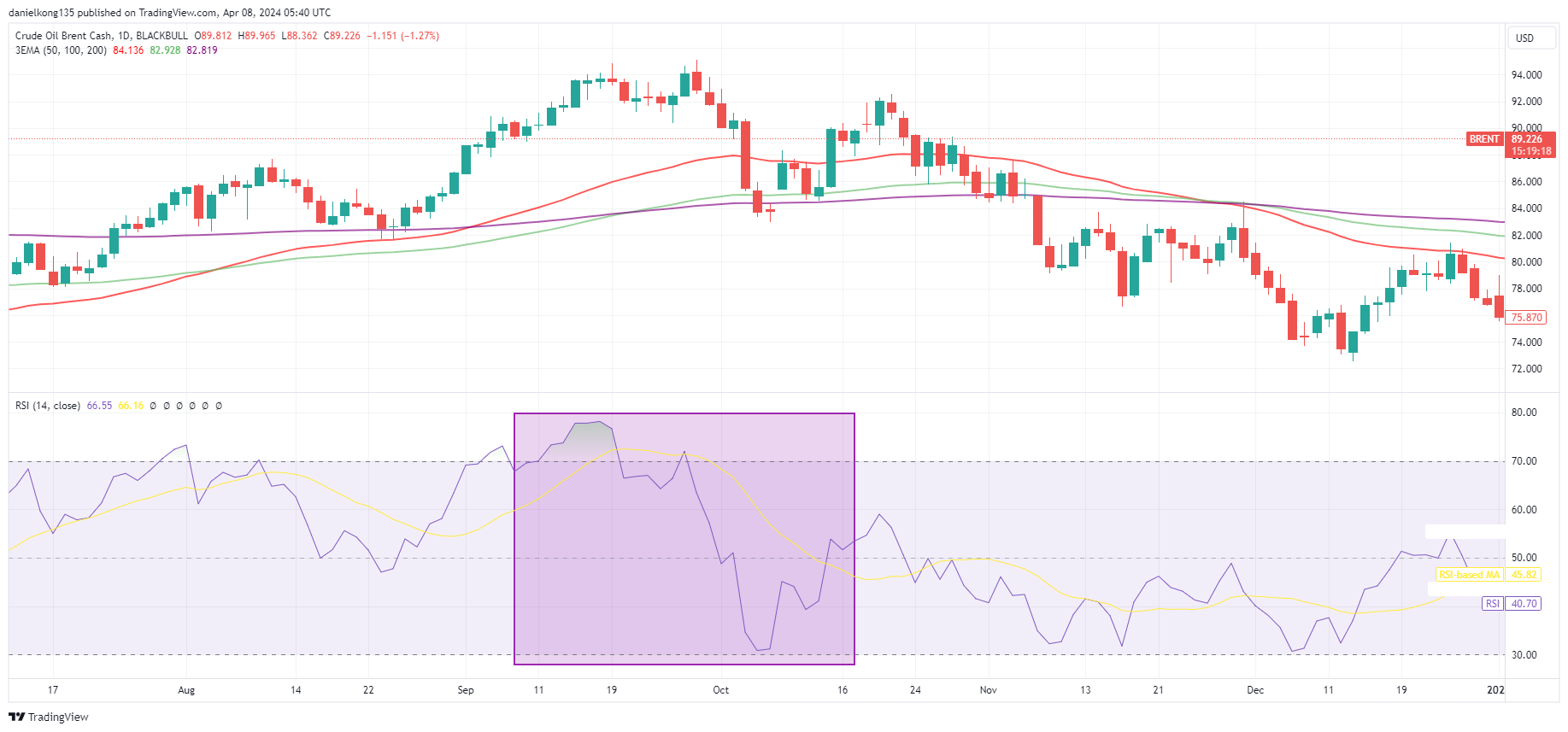
The screenshot above shows a price chart for Brent crude oil, covering the period from August to December 2023.
The main price chart consists of red and green candlesticks. Superimposed over them is the Triple Exponential Moving Average (3EMA), represented by the red (50-day), green (100-day), and purple (200-day) lines.
In the bottom half of the screen, you will find the Relative Strength Index (RSI).
3EMA for Brent crude oil trading
A moving average filters out daily market “noise” by creating a constantly updated average price. This helps traders confirm broader trends and identify key support and resistance levels. While simple moving averages treat all data equally, exponential moving averages (EMAs) place more weight on recent prices, making them more responsive to sudden shifts.
The 3EMA plots three distinct timeframes—a fast (20-day), medium (50-day), and slow (200-day) average.
Here is how traders read the interplay between these lines:
- Bullish Signal: When a faster EMA crosses above a slower one.
- Bearish Signal: When a faster EMA crosses below a slower one.
While you can trade with just two moving averages, adding a third, longer-term line provides a much stronger confirmation that a trend is genuine.
Returning to the chart, look at the price action starting in late October. You can see the fast red moving average (50-day) distinctly crossing under the green (100-day) moving average, and shortly after, in November, crossing under the purple (200-day) line as well. This confirmed that a bearish trend was well and truly underway. Traders expect this downward pressure to continue until the red moving average bottoms out, reverses, and crosses back above the longer-term lines.
RSI for Brent crude oil trading
The Relative Strength Index (RSI) is a momentum oscillator used to show when an asset is over-traded or under-traded. The index ranges from 0 to 100, with 30 and 70 as the customary boundaries.
- Under 30 (Oversold): Indicates under-trading.
- Over 70 (Overbought): Indicates the asset is over-traded. The price is likely inflated.
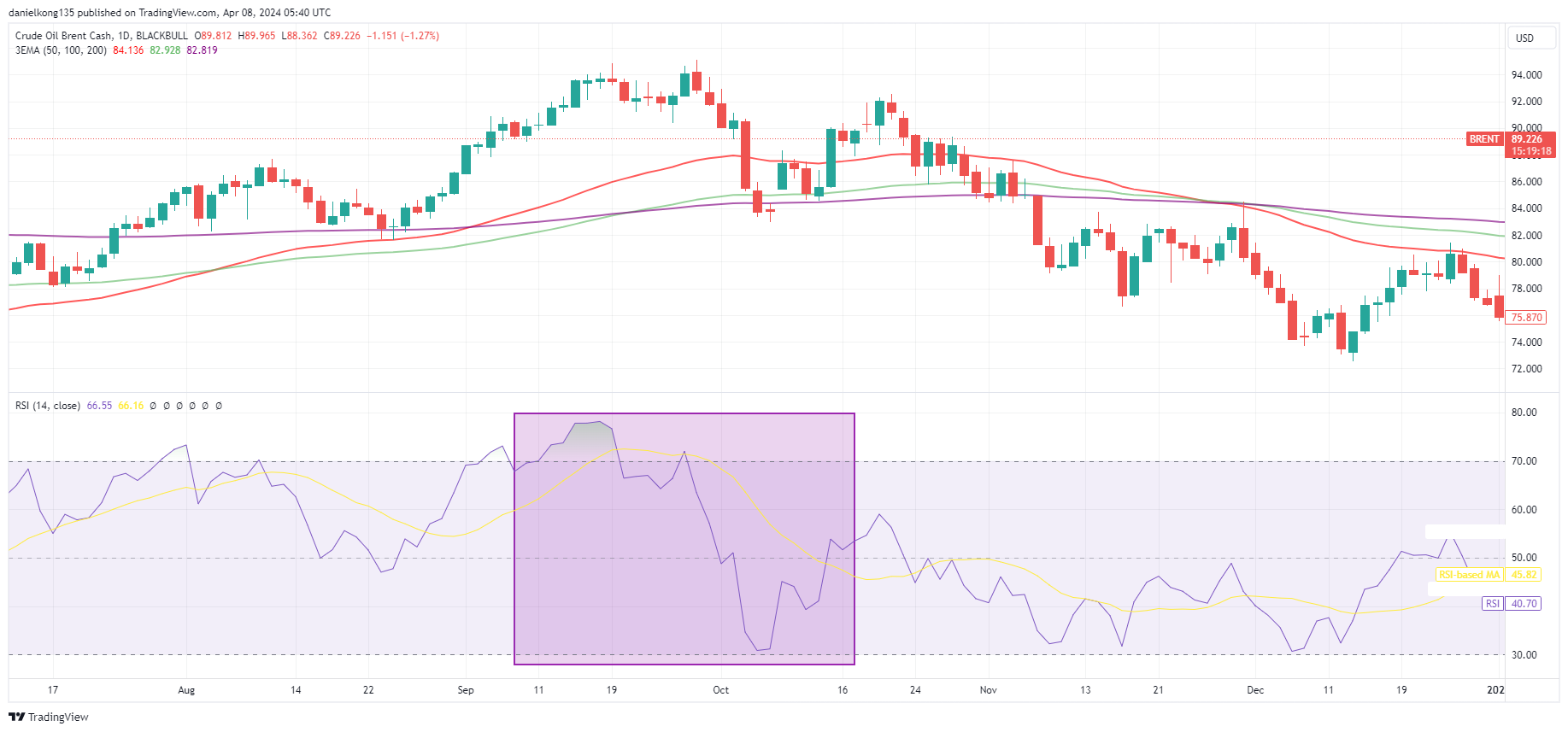
Take another look at the screenshot. The RSI is located in the bottom half of the screen. The main index is the purple line (for this example, we can ignore the yellow RSI moving average line).
Pay close attention to the highlighted purple rectangle spanning roughly from September to mid-October. Notice how in mid-September, the RSI pushed aggressively above the 70 mark, indicated by the green-shaded peak?
This was an unusual event; in the months prior, the 70 line had barely been breached. This spike into “overbought” territory was a massive red flag that Brent crude was overpriced at that exact moment. The main price chart confirmed this, showing the candlesticks peaking at around $94.
Judging strictly by the RSI, traders knew that long (buy) positions should be aggressively avoided at that point. Indeed, soon after that overbought signal flashed, the price of Brent crude oil reversed course and began a massive, multi-month plunge down into the $70 range.
Risk management when trading Brent crude oil
Crude oil is a notoriously volatile commodity. History is full of wild price swings, and Brent crude oil is no exception. Because the market is highly sensitive to geopolitical events and macroeconomic shifts, predicting Brent crude oil prices can be a complex and unpredictable challenge.
To protect your capital, it is crucial to implement these core risk management measures:
Proper trade sizing
It can be tempting to place a large bet in hopes of a massive payoff, but this lack of discipline often leads to heavy losses. Instead, you should stick to a consistent trade size regardless of how confident you feel about a specific move in Brent crude oil prices.
- The Golden Rule: Generally, you should risk no more than 1% to 2% of your total capital on any single trade. As your account grows, you may even consider reducing this percentage further to protect your gains [17].
Caution when using leverage
Many traders use CFDs to gain exposure to the Brent oil price because they allow for leverage. While leverage lets you trade with less upfront capital, it acts as a double-edged sword by amplifying both profits and losses.
- The Risk: In extreme cases, leverage can cause losses exceeding your initial deposit, resulting in a negative account balance.
- The Strategy: Use leverage sparingly. It is best reserved for when you have built up enough experience and emotional discipline to handle the increased stakes.
Setting stop-losses and take-profit levels
To remove emotion from the equation, traders use predetermined price points to close their positions automatically.
- Stop-Loss: It closes a losing trade at a specific price to prevent a bad situation from becoming a catastrophic one.
- Take-Profit: This helps you avoid overtrading. It closes a winning trade once a target price is hit, locking in your gains before the market has a chance to reverse.
Brent Crude Oil Trading Strategies
Earlier, we mentioned that you should build your own set of trading strategies as you learn and hone your skills as a Brent crude oil trader. This is to help you instil discipline in your trading by learning to play within the rules.
Here are some common Brent crude oil trading strategies:
Day trading
Day trading involves making multiple short-term trades that last anywhere from a few minutes to several hours. Day traders rarely hold positions overnight. They aim to capture small returns from Brent crude oil prices throughout a single session.
Because the movements are small, day traders often use leverage to amplify their results, though this significantly increases the risk of loss.
Position trading
In contrast to day trading, a position-trading strategy involves holding a position in the Brent crude oil market over a longer time frame. The goal is to make a profit when the market moves in a favourable direction.
Position traders may use both long and short positions to hedge against risk and to expand the range of trading opportunities in the crude oil market. This strategy is well-suited to a variety of Brent crude oil instruments, including oil stocks and ETFs.
Swing trading
Swing trading attempts to reap returns when the price swings from up to down or down to up over several days or weeks. This involves speculating on expected Brent crude oil price movements based on market sentiment, macroeconomic news or geopolitical events. Some swing traders also rely on technical analysis to identify an upcoming swing.
This trading strategy is slower paced than day trading, as traders have the option to keep their trades open for significantly longer durations – typically all the way until the swing runs its course.
Read our guide on “Position Trading vs Swing Trading” to help you understand each strategy better.
Trend following
The core idea here is simple: trade with the trend, not against it.
If the overall Brent oil price is climbing, you take a long position; if it’s falling, you go short. Success depends on accurately identifying the trend’s momentum using technical indicators and having the discipline to exit once the trend ends.
Trend traders make use of an array of technical indicators on a price chart to gauge trend momentum and direction. Read our article on trend analysis guide and learn how you can implement this technical analysis technique to your trades.
Sentiment trading
This strategy is based on the overall “mood” of the market.
When the outlook is optimistic, and prices are expected to rise, sentiment traders open long positions. When the mood turns sour, they might switch to short-selling.
Because the Brent crude oil market is so volatile, it takes a lot of experience to filter out temporary “noise” and focus on the sentiment that actually drives the market.
News trading
News trading focuses on making moves immediately following major announcements.
Earnings reports from major oil companies, political elections, and economic data (such as inflation or employment levels) can cause immediate spikes or declines in Brent crude oil prices.
A successful news trader must be able to quickly evaluate a report and react faster than the rest of the market.
Brent crude oil trading hours
The trading hours for Brent crude depend on the instrument chosen. Brent futures trading hours follow that of the exchange on which they are offered, whereas instruments such as CFDs, stocks and ETFs are available for trade according to the online brokerage you choose.
Brent crude futures trading hours on Intercontinental Exchange Inc (ICE) [18]
| City | Trading hours | Pre-open |
| New York | 8pm to 6pm (next day) | 7.45pm |
| London | 1am to 11pm (next day) | 12.45am |
| Singapore | 9am to 7am (next day) | 8.45am |
On Sundays, pre-open is at 10am and markets open at 11am onwards, London local time.
Brent CFDs
Vantage offers trading in Brent CFDs during the following time periods:
| Description | Symbol | Trading time (GMT+2) |
| Brent Crude Oil Cash | UKOUSD | Monday:01:00-24:00 Tuesday – Friday:03:00-24:00 |
| Brent Crude Oil Future | UKOUSDft | Monday:01:00-24:00 Tuesday-Friday:00:00-01:0003:00-24:00 |
Key takeaways for Brent crude oil trading
As one of the most important and actively traded commodities, Brent crude offers many opportunities for traders and investors.
Before you dive in, keep these core principles in mind:
- Volatility: Brent prices are hyper-sensitive to geopolitical events, macroeconomic developments, and breaking market news.
- The Futures Factor: Because the vast majority of Brent crude is traded via futures contracts, market sentiment can easily be amplified, leading to rapid and aggressive price swings.
- Match Your Instrument to Your Experience: Advanced instruments such as futures and options carry high risk and are generally unsuitable for beginners. If you are a newer investor or have a longer time horizon, tracking the market through Brent ETFs or energy stocks is a much more manageable starting point.
Ultimately, the Brent crude market demands discipline, rapid responses, and robust risk management. However, for those willing to invest the time to master its complexities, few other commodities offer the same level of excitement and potential reward.
Trade Brent crude CFDs with tight spreads at Vantage
Trade Brent crude via CFDs with Vantage and experience the difference. Sign up now and enjoy a deposit bonus* to boost your first trade!
Ready to put your knowledge into action? Vantage allows you to trade Brent crude via CFDs at minimum cost, featuring tight spreads starting from just 0.0.
- Complete Transparency: Enjoy lower costs with no deposit fees, no monthly rollover fees, and no hidden charges.
- World-Class Platforms: Choose from MT4, MT5, or trade anywhere on the go with the Vantage mobile app. All of our platforms are packed with powerful features that allow you to react instantly to the latest oil market developments.
- Ultimate Flexibility: Deploy long and short strategies to capture potential gains no matter which way the market is trending, and protect your capital with our array of flexible risk management tools.
Trade Brent crude via CFDs with Vantage and experience the difference. Sign up now and enjoy a deposit bonus* to boost your first trade!
Terms & Conditions apply*.
Frequently Asked Questions (FAQs)
Q1. What is the spread on Brent crude oil assets at Vantage?
We offer tight spreads for Brent CFDs, starting from as low as 0.0. Trade at minimum cost with Vantage.
Q2. What are the risks of Brent crude oil trading?
Brent crude oil prices are highly volatile, posing a major risk for investors and traders. As the main benchmark for the world’s most important commodity, Brent crude can be impacted by a wide number of events, news, developments and factors, some more apparent than others. Wild price swings are not uncommon in Brent’s historical prices.
Proper risk management must be practised when trading Brent crude oil. Investors should also expect to invest substantial time and effort in studying and understanding the market, and be prepared to be proven wrong at any time.
Q3. Why is Brent oil more expensive than WTI crude oil?
Because both Brent crude and WTI crude share similar characteristics as sweet and light crude oils, their prices are strongly correlated. However, due to differences in extraction locations, transportation, and exchange listings, the prices of Brent and WTI may diverge at times, with one trading above the other.
In other words, it is not always true that Brent oil is more expensive than WTI crude oil, as the reverse has also happened before. Importantly, the two commodities may respond differently to geopolitical and local economic forces.
Q4. What are the additional tips for trading Brent crude oil?
The Brent crude market can undergo wild price swings that may be hard to anticipate. Thus, traders should equip themselves with the means to track key market news and developments easily and the ability to respond quickly to capitalise on upcoming opportunities.
This means choosing an online brokerage that offers fast, reliable connectivity and feature-rich trading platforms with a range of flexible, powerful tools, enabling effective trading in the fast-paced Brent crude oil markets.
Q5. What is the difference between Brent crude oil and WTI crude oil?
The main difference between Brent crude and WTI crude is the location of extraction.
Brent crude oil refers to a blend of light and sweet crudes extracted from the North Sea region, which is part of the Atlantic Ocean and northern Europe. WTI crude oil is extracted from fields in the United States, namely Texas, North Dakota, and Louisiana.
The difference in extraction location between the two has led to alternative names: European crude for Brent and American crude for WTI. There are also differences in storage, transportation, and distribution due to the distinct nature of the two extraction regions.
Additionally, while both Brent crude and WTI crude are classified as light and sweet crudes, there are slight variations between them in terms of density and sweetness. Learn all about their differences here.
Q6. Can I practise Brent crude oil trading?
Yes. Traders and investors wishing to practise Brent crude trading and test out trading strategies on paper may do so by signing up for a free Vantage demo account. There are no fees or minimum deposit required to practise Brent oil trading with a demo account.
References
- “Energy Investing Basics: WTI vs. Brent Crude Oil – Charles Schwab”. https://www.schwab.com/learn/story/energy-investing-basics-wti-vs-brent-crude-oil . Accessed 5 April 2024.
- “BrentTM the world’s crude benchmark – ICE”. https://www.ice.com/insights/market-pulse/brent-the-worlds-crude-benchmark . Accessed 5 April 2024.
- “The North Sea—A Long and Proud History – TheWayAhead”. https://jpt.spe.org/twa/the-north-sea-a-long-and-proud-history . Accessed 5 April 2024.
- “North Sea Brent Crude: Meaning, Investing, History – Investopedia”. https://www.investopedia.com/terms/n/northseabrentcrude.asp . Accessed 5 April 2024.
- “How Oil Prices Affect the Stock Market – Investopedia”. https://www.investopedia.com/ask/answers/030415/how-does-price-oil-affect-stock-market.asp . Accessed 5 April 2024.
- “Navigating Oil Price Risk – ICE”. https://www.ice.com/insights/market-pulse/navigating-oil-price-risk . Accessed 5 April 2024.
- “The 2008 Oil Price Shock: Markets or Mayhem? – Resources.org”. https://www.resources.org/common-resources/the-2008-oil-price-shock-markets-or-mayhem/ . Accessed 5 April 2024.
- “What triggered the oil price plunge of 2014-2016 and why it failed to deliver an economic impetus in eight charts – World Bank Blogs”. https://blogs.worldbank.org/en/developmenttalk/what-triggered-oil-price-plunge-2014-2016-and-why-it-failed-deliver-economic-impetus-eight-charts . Accessed 5 April 2024.
- “Average annual Brent crude oil price from 1976 to 2024 – Statista”. https://www.statista.com/statistics/262860/uk-brent-crude-oil-price-changes-since-1976/ . Accessed 7 April 2024.
- “POLL Economic risks to stifle oil’s gains in 2024 despite OPEC+ cuts – Reuters”. https://www.reuters.com/business/energy/economic-risks-stifle-oils-gains-2024-despite-opec-cuts-2023-11-29/ . Accessed 5 April 2024.
- “Oil Price Shock Would Hit 2024 Growth and Boost Inflation – FitchRatings”. https://www.fitchratings.com/research/sovereigns/oil-price-shock-would-hit-2024-growth-boost-inflation-10-11-2023 . Accessed 5 April 2024.
- “What Determines Oil Prices? – Investopedia”. https://www.investopedia.com/articles/economics/08/determining-oil-prices.asp . Accessed 5 April 2024.
- “Oil Market and Russian Supply – IEA”. https://www.iea.org/reports/russian-supplies-to-global-energy-markets/oil-market-and-russian-supply-2 . Accessed 5 April 2024.
- “Oil ETF: What It is, How it Works, and Challenges – Investopedia”. https://www.investopedia.com/terms/o/oil-etf.asp . Accessed 5 April 2024.
- “Brent climbs 5.5% amid Middle East tensions – Economies.com”. https://www.economies.com/commodities/brent-oil-news/brent-climbs-5.5-amid-middle-east-tensions-43493 . Accessed 5 April 2024.
- “Brent falls below $80 for the first time in two months following the collapse of Silicon Valley – Economies.com”. https://www.economies.com/commodities/brent-oil-news/brent-falls-below-$80-for-the-first-time-in-two-months-following-the-collapse-of-silicon-valley-42532 . Accessed 5 April 2024.
- “Risk Management Techniques for Active Traders – Investopedia”. https://www.investopedia.com/articles/trading/09/risk-management.asp . Accessed 5 April 2024.
- “Brent Crude Futures – ICE”. https://www.ice.com/products/219/Brent-Crude-Futures . Accessed 5 April 2024.


